Art deco just turned one hundred. The style took its name from the 1925 Exposition Internationale des Arts Décoratifs in Paris, and a century later its centenary has done exactly what centenaries do: put sunbursts, stepped forms and gold geometry back on mood boards everywhere. After years of beige minimalism, rooms are hungry for a little glamour again, and art deco wall art is the fastest way to get it without re-tiling a bathroom in emerald marble.
The trouble is that “art deco” gets slapped on anything with a gold frame. This guide breaks the style down to its five signature motifs, so you can spot the real thing, choose pieces with confidence, and style them without turning your living room into a theme bar.
Jump to: Why deco is back · 60-second history · The 5 signature motifs · How to style it · Room by room · Getting the quality right · Quick answers
Why Art Deco Is Back in 2026
Three forces are pulling in the same direction. First, the centenary itself: museums from Paris to New York have spent the past year celebrating 1925, and that coverage trickles down into interiors fast. Second, fatigue. A decade of greige walls and whisper-quiet decor left many homes feeling more like waiting rooms than places people actually live. Deco is the antidote: confident, ornamental, and unafraid of a gold accent.
Third, and most interesting, is how well deco plays with what people already own. Its DNA is geometric, which means it sits comfortably next to the mid-century modern wall art and clean-lined furniture that dominate modern homes. You are not replacing a look; you are giving it jewellery.
Art Deco in 60 Seconds
A little context makes the motifs click. Deco emerged from that 1925 Paris exposition as the machine age’s answer to the flowing curves of art nouveau: where nouveau imitated vines and dragonflies, deco celebrated pistons, skyscrapers and ocean liners. It swept through the late twenties and thirties, gave the world the Chrysler Building, Radio City Music Hall and half of Miami Beach, then went quiet after the war, dismissed as old-fashioned glitz.
Every few decades since, it resurfaces: the 1970s revival, the Gatsby moment of the 2010s, and now the centenary wave. Each return keeps the geometry and drops a little more of the gilt, which is why today’s deco prints feel at home in modern interiors: the shapes carry the glamour, no chandelier required.
The 5 Signature Motifs (and How to Spot Them)
Strip away the glamour and art deco is a vocabulary of five shapes. Learn them and you will never mistake generic geometry for the real thing again.
1. The Sunburst
Rays fanning out from a central point, like a stylised sunrise. It is the most optimistic shape in design history, born in an era that believed in progress, and it still reads that way on a wall. Look for even ray spacing and a strong centre. A sunburst wants to be the focal point of a room, hung solo with generous space around it, ideally centred over a sofa, bed or mantel.
2. The Fan and the Scallop
Overlapping quarter-circles, repeated like fish scales or a hand of cards. The fan is deco at its most elegant, softer than the sunburst but just as rhythmic. It suits bedrooms and dining rooms, where its repetition feels calm rather than busy. In print form, fans in muted gold on deep green or navy are the closest thing to a guaranteed win.
3. The Stepped Form
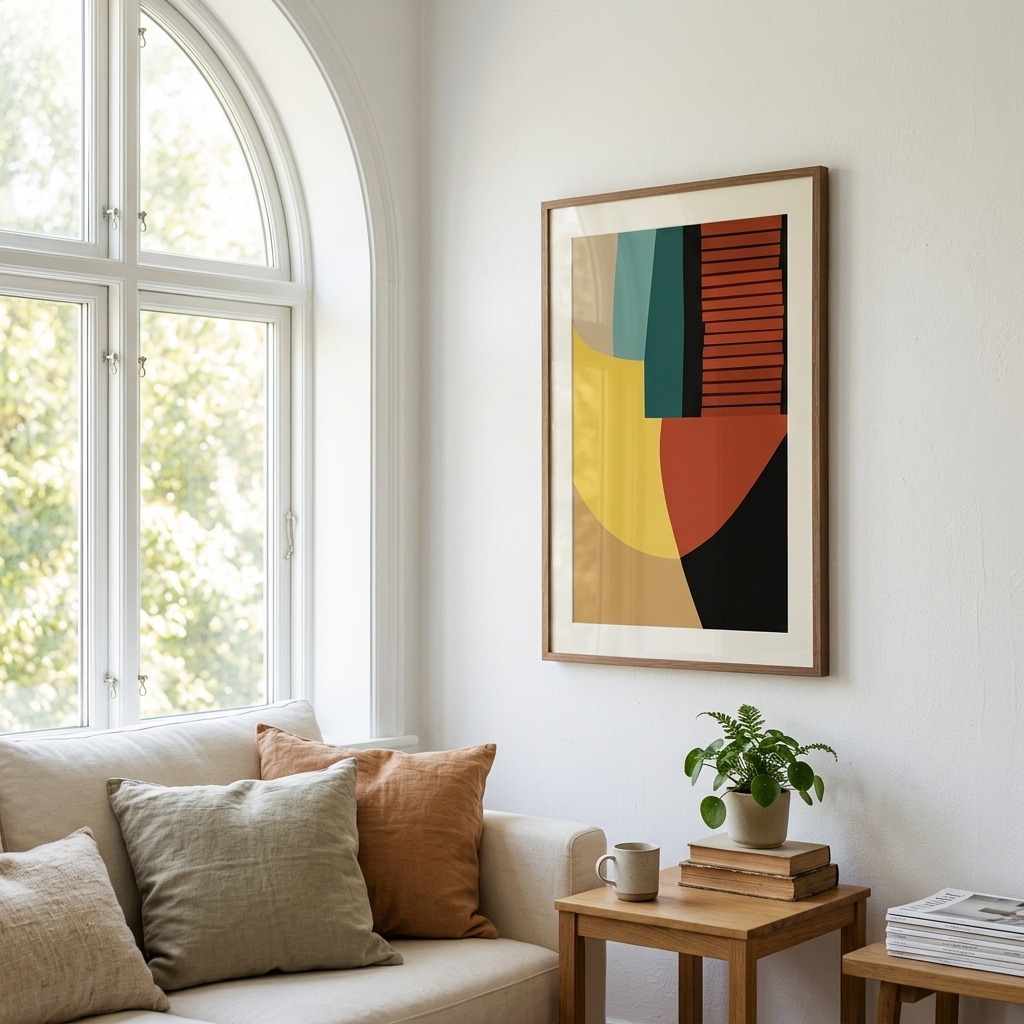
Think of the Chrysler Building’s crown, finished in 1930 and still the most famous deco silhouette in the world. Stepped forms, sometimes called ziggurats, climb in confident tiers. On paper they bring architecture into a room, which makes them perfect for entrances, hallways and offices, anywhere you want a sense of ambition rather than softness. For a bolder take on the same idea, our guide to silhouette art shows how a single dark form can anchor a whole wall.
4. The Chevron
Sharp, repeating V shapes. The chevron is deco’s most graphic motif and the easiest to get wrong: too many rows in loud colours and you have wrapping paper. Done right, in black and white or charcoal and cream, it delivers crisp energy that pairs beautifully with black and white geometric prints in a gallery arrangement.
5. The Arc
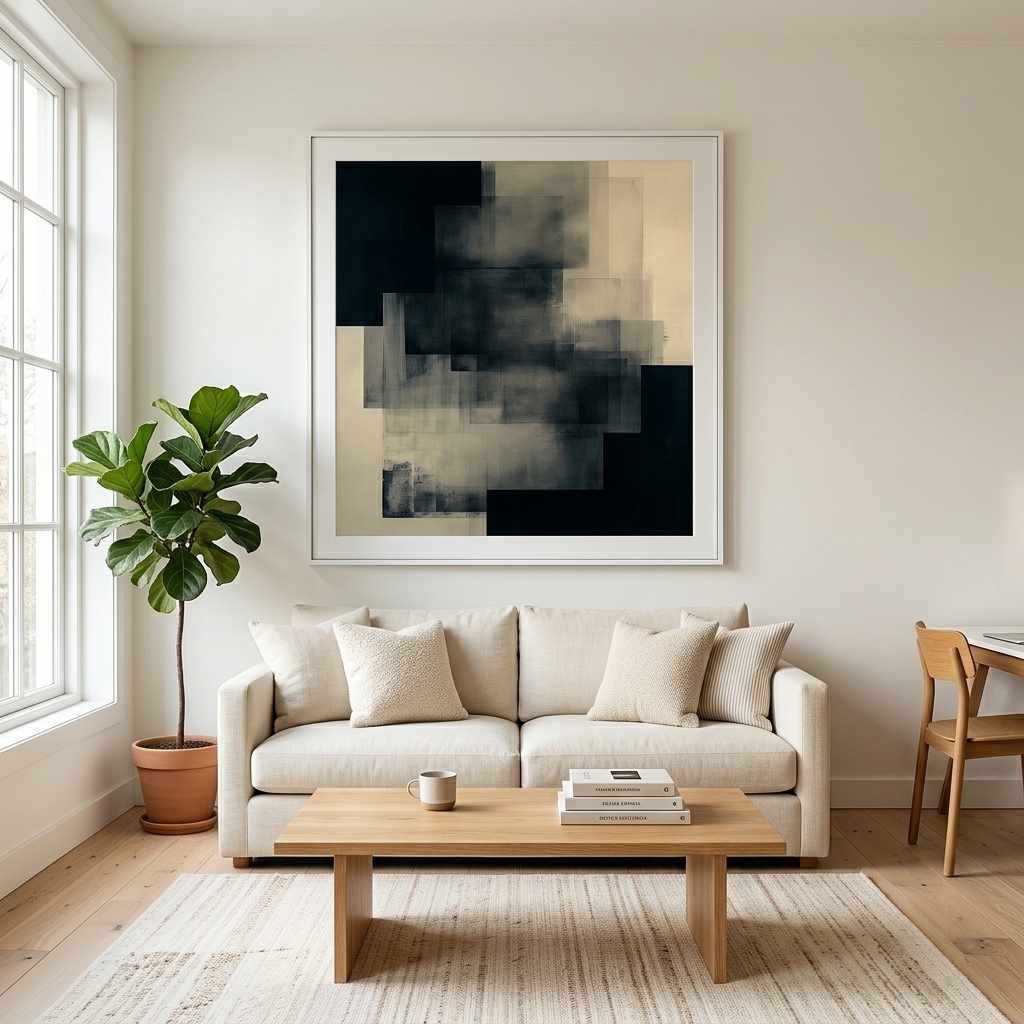
Perfect curves, usually mirrored or stacked. Arcs are where deco meets Bauhaus, and they are the motif that ages best in contemporary rooms because they feel geometric without feeling period-locked. If you are deco-curious but nervous, start with arcs: they whisper the style rather than shouting it.
How to Style Art Deco Prints Without the Theme-Bar Effect
One rule above all: let a single piece lead. Deco is a strong flavour, and the fastest way to ruin it is to sprinkle it everywhere. Choose one statement print, roughly 24×36 in (60×90 cm) for a sofa or bed wall, and let the rest of the room respond to it.
Frames do heavy lifting here. Slim gold or brass frames complete the look; slim black frames modernise it. Wide ornate frames fight the geometry, so leave them for oil portraits. On the wall itself, deco prints glow against deep jewel tones and warm neutrals alike, and their gold notes pick up beautifully in brass lamps, hardware and mirror frames.
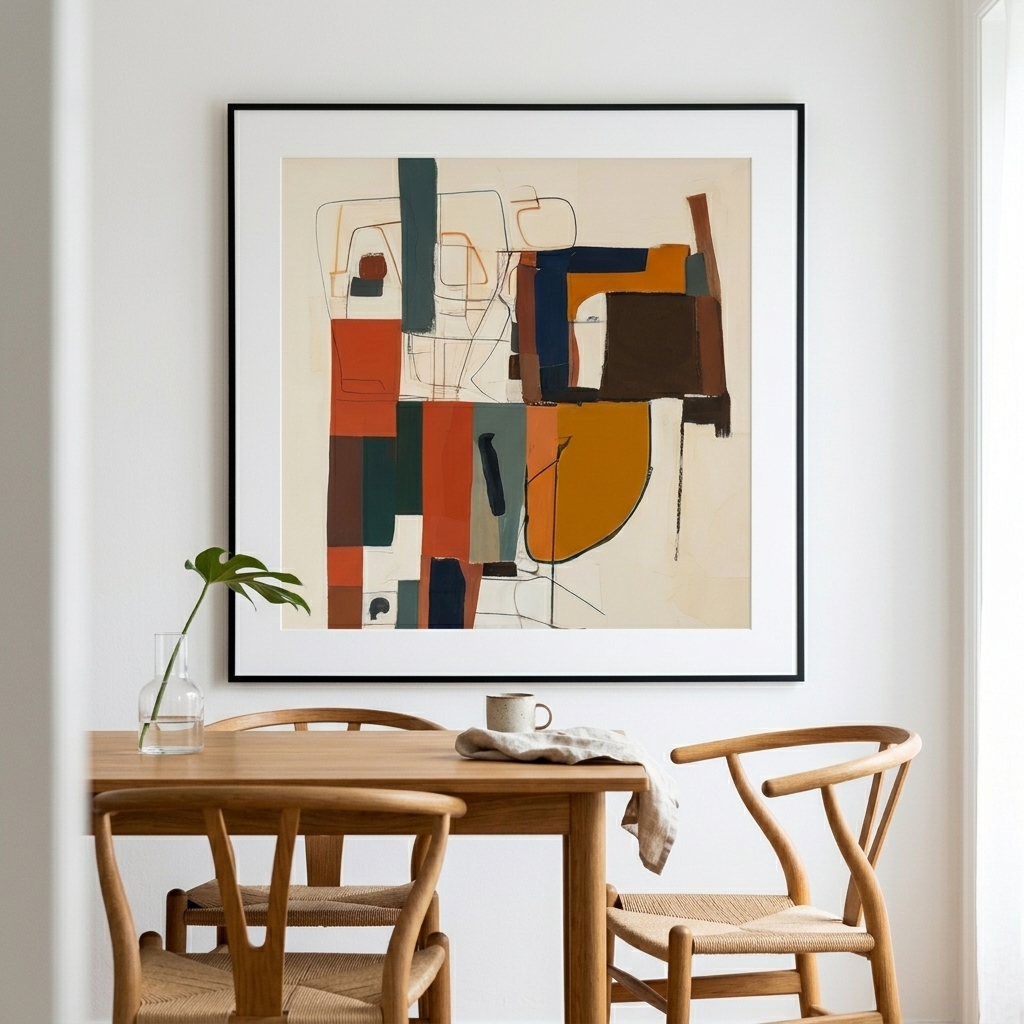
Deco also mixes generously. Its flat, confident shapes sit naturally beside color block art, and a deco piece in an otherwise collected, softer room of vintage wall art reads as the sophisticated cousin who arrived overdressed and somehow made everyone else look better. We looked at that retro-modern layering in more depth in our piece on the mid-century modern revival.
Where to Hang It: Room by Room
Living room. The natural stage. One statement piece above the sofa, centred, with its bottom edge roughly 8-10 in (20-25 cm) above the backrest. Sunbursts and large arcs work hardest here, and a pair of matching brass sconces either side is the full period treatment without a single reproduction poster in sight.
Dining room. Deco was built for entertaining, and it shows. A symmetrical pair of fan or arc prints over a sideboard gives dinner a sense of occasion; keep the frames identical so the rhythm stays formal.
Bedroom. Go softer: muted golds, blush and deep green rather than high-contrast black. A single wide piece above the headboard, or a calm arc pair, reads as boutique hotel rather than casino floor.
Home office. Stepped forms and structured grids belong here. There is something about that skyscraper geometry that makes a desk feel more decisive; a 18×24 in (45×60 cm) vertical beside a shelf unit does it without dominating video-call backgrounds.
Hallway and entry. First impressions are deco’s home turf. One confident piece by the door, hung at eye level around 57-60 in (145-152 cm) to centre, sets the tone for the whole home in the two seconds it takes to walk past.
Green’s own room, from sage to forest, is the green wall art collection.
Where water turns abstract, the abstract ocean art collection holds the horizon line.
Getting the Quality Right
Deco is unforgiving of cheap printing. The style lives on razor-sharp edges and rich, saturated tone: a fuzzy chevron or a gold that prints as flat mustard kills the whole effect. Two things to check before you buy.
First, originality. A century of fame means the market is flooded with low-resolution scans of old posters. Original designs created in the deco spirit, like the pieces in our collection, give you the vocabulary of 1925 with the crispness of a modern file prepared for print.
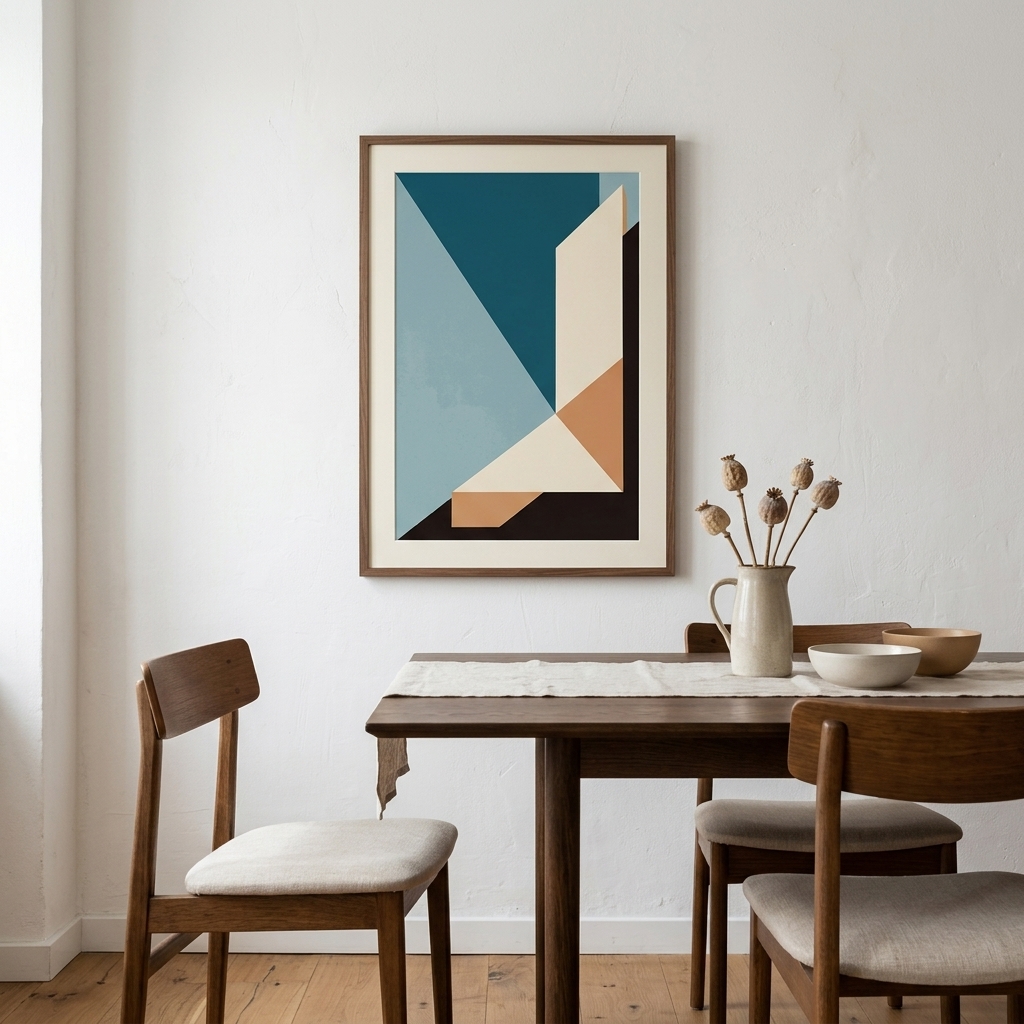
Second, materials. We print on 230gsm fine art paper, where deco’s deep greens, blacks and golden ochres come out matte, precise and glare-free, or on cotton canvas for a warmer, mural-like presence. Either way, archival Giclée inks keep the colours honest for around 75 years, which feels appropriately deco: built to outlast the trend cycle that revived it.
Quick Answers
Is art deco wall art too bold for a small room?
No, but scale down and simplify: one arc or fan print in a 16×20 in (40×50 cm) frame gives a small room glamour without crowding it. Skip busy chevrons in tight spaces.
What colours work with art deco prints?
Gold, black, cream, emerald and navy are the classic set. If your room is neutral, the print supplies the drama; if your walls are dark, gold-toned deco pieces will glow against them.
Paper or canvas for art deco prints?
Fine art paper in a slim gold or black frame is the classic route: the matte 230gsm surface keeps edges razor sharp, which deco geometry demands. Canvas suits larger arcs and softer palettes, where a little texture adds warmth.
Can I mix art deco with a minimalist home?
Yes, and it is one of the best pairings going: one deco statement in a pared-back room reads as intentional and collected rather than themed. Keep the rest of the walls quiet and let it hold court.
Ready to bring a little 1925 home? Explore the full art deco wall art collection: original, artist-made designs, printed to order and shipped worldwide, with free shipping on orders over $69.