There is a famous piece of film from 1949 of Pablo Picasso drawing with light in a darkened room, producing an entire bull, a figure, a whole composition in a single unbroken gesture, without ever stopping the line. It takes seconds. It looks like the easiest thing in the world. It is, in fact, the product of a lifetime of drawing, and it captures exactly why continuous-line art holds a peculiar power that more detailed work often lacks.
The continuous line — one stroke, never lifted, describing a face or a body or a plant in a single flowing movement — is one of the most deceptively difficult things an artist can attempt. There is no erasing, no correcting, no building up of tentative marks. The line commits, and it either finds the form or it does not. When it works, the result has a liveliness and immediacy that a careful, shaded, photorealistic drawing can never quite reach. And when it hangs on a wall, that same aliveness is what your eye responds to, whether or not you know why.
Why the simplest drawings are the hardest
It seems backward. Surely a detailed, realistic drawing is harder than a few flowing lines? But ask anyone who draws and they will tell you the opposite is true. Detail gives you room to hide — a thousand marks blur into an impression, and mistakes disappear into the density. A single continuous line hides nothing. Every hesitation shows. The confidence or uncertainty of the hand is fully exposed. This is why the greatest artists, Picasso and Matisse chief among them, turned to line work late in their careers, once they had earned the certainty it demands.
Matisse spent decades painting in dense, saturated color, then in his final years reduced everything to line and cut-out shape — and considered that late, spare work the summit of his life. The reduction was not a decline or a shortcut. It was the distillation of everything he knew into the fewest possible marks. That is the quiet story behind every good line drawing: an apparent simplicity that is actually the end point of enormous skill, not the beginning of it.
What a single line does to a room
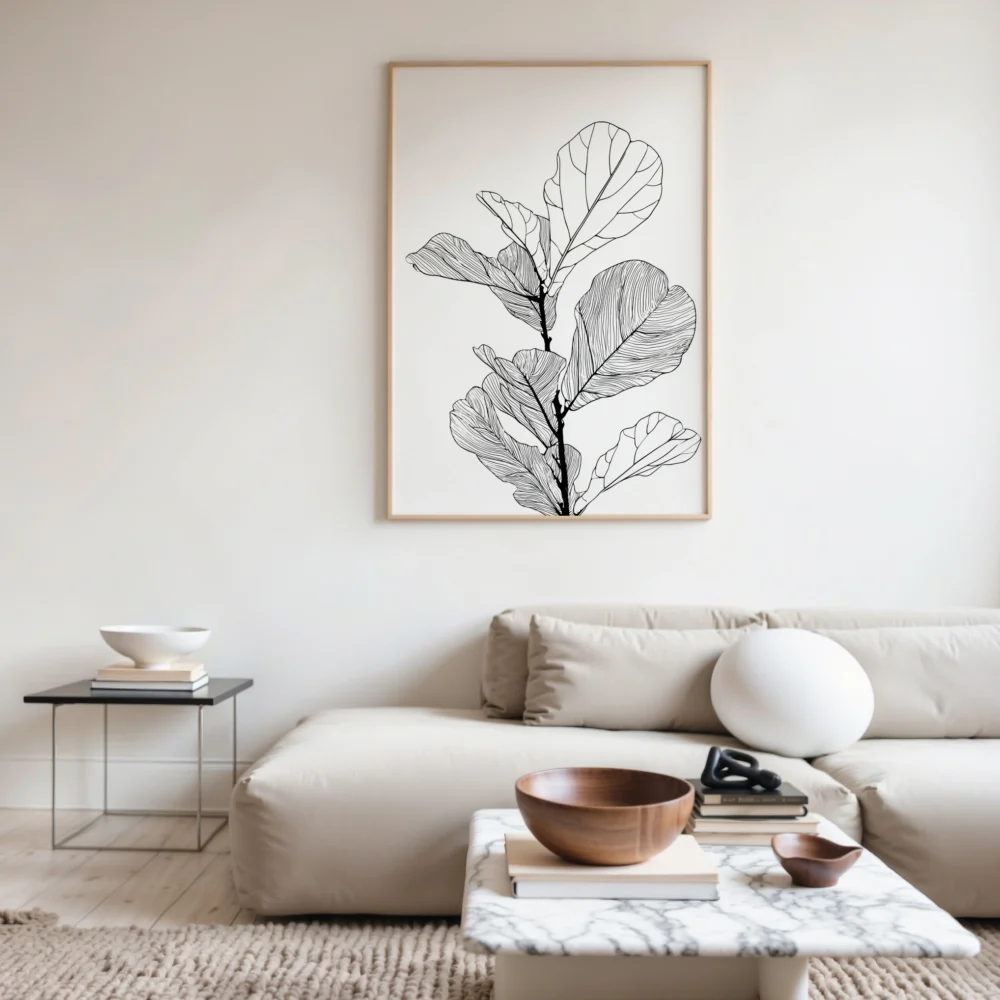
On a wall, line art behaves unlike almost anything else. Because it is so spare — a form floating in open white space — it introduces calm rather than busyness. It gives the eye a single, elegant gesture to follow and a great deal of quiet around it. In a room already carrying a lot of texture, pattern, or color, a line drawing is a moment of visual rest, a clean breath in a busy composition.
It is also unusually adaptable. A continuous-line figure or botanical carries no color to fight your palette and no heavy detail to compete with your furnishings. It works in a minimalist room, where it reinforces the restraint, and equally in a maximalist one, where it provides relief. This quiet flexibility is why a single line so often says more than a fully rendered image — it asks nothing of the room except a little space, and gives back a sense of considered ease.
The intimacy of the gesture
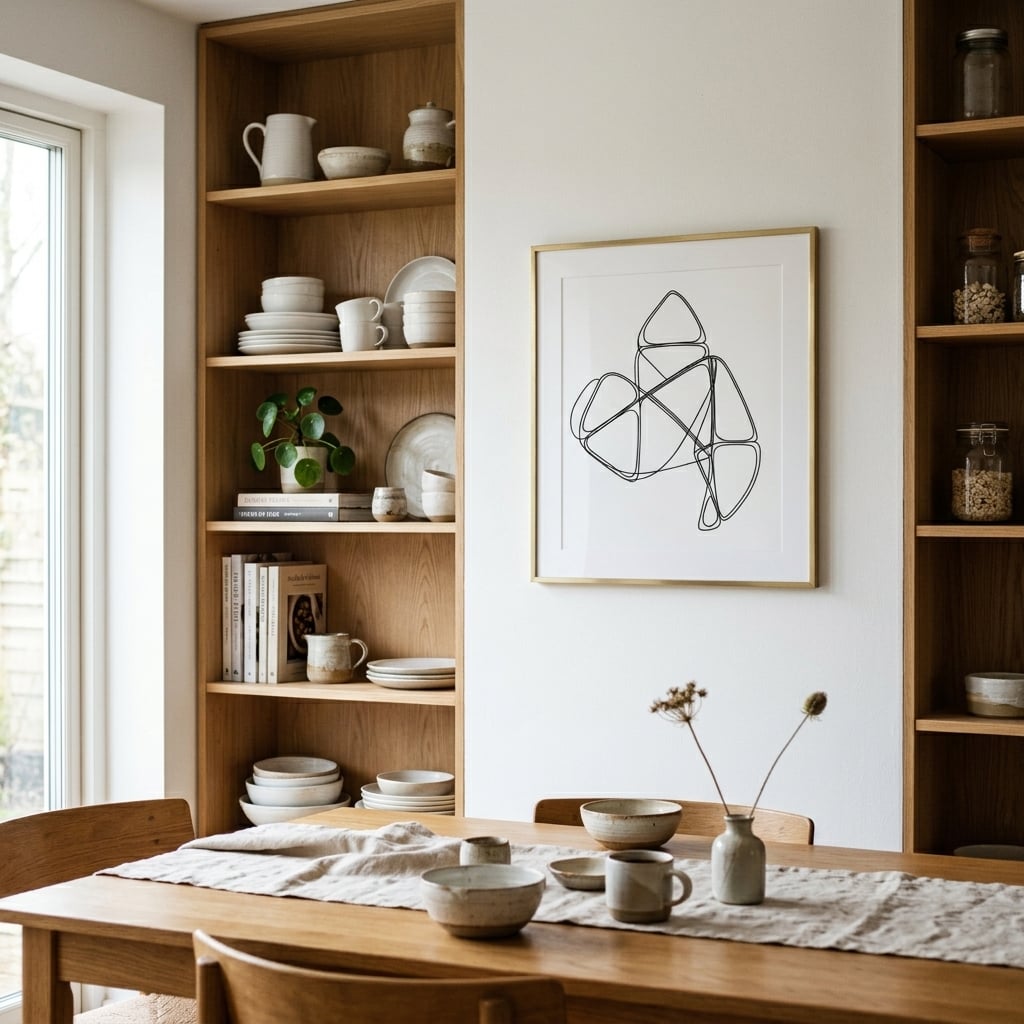
There is something else line art offers that detailed work struggles to. Because you can see the whole path of the line — where it began, where it flowed, where it closed — you are, in a sense, watching the artist draw. The gesture is preserved and visible. You follow the hand’s movement with your eye and re-enact it. That creates a strange intimacy: the piece feels handmade and human in a way that a smooth, detailed, machine-perfect image never can, even when both are printed identically.
That human trace is worth protecting in how you display it. Line art wants space and it wants a clean, uncluttered mount — heavy ornate framing fights the lightness of the gesture entirely. A simple frame, a generous white margin, plenty of quiet wall around it. Let the single line be the only event in its immediate space, and it will hold that space with an ease that busier, more expensive-looking art often cannot.
The Japanese and the single brushstroke
The Western continuous line has a close cousin in the East, and the comparison deepens the point. In Japanese and Chinese ink painting, the single confident brushstroke is a discipline pursued for centuries — the ensō, the hand-drawn circle of Zen practice, is drawn in one uninterrupted movement and is understood to reveal the state of mind of the person drawing it. A hesitant circle betrays a hesitant mind; a confident one, a settled one. The mark is a portrait of the moment it was made.
This is the same truth Picasso and Matisse arrived at from the other direction: that a single line, drawn without correction, records not just a form but the spirit in which it was made. There is no hiding in it. The unbroken line is honest in a way that layered, revised, buildable media are not. When you hang a piece of line art on a wall, part of what gives it life is this embedded honesty — the sense that you are looking at a single, committed human gesture, preserved exactly as it happened.
Where line art works hardest
Line art earns its place most in rooms that risk feeling heavy or busy. A space full of texture, pattern, and layered color needs somewhere for the eye to rest, and a spare line drawing provides exactly that — a clean, quiet breath in a crowded visual field. It is the design equivalent of white space on a page: not empty, but restful, and essential to making everything around it legible.
It also does quiet work in transitional spaces — hallways, stairwells, the wall beside a doorway — where a busier or more demanding piece would feel like too much for a space you move through rather than sit in. A single line drawing suits these in-between places precisely because it asks so little and gives so much. This is a large part of why a single line so often says more: it fits where fuller art would crowd, and it calms where fuller art would clamor.
Choosing line art that lasts
Not all line work is equal, and the difference between a piece that holds up for years and one that quickly bores comes down to the quality of the line itself. A good line drawing has confidence and economy — it describes its subject with the fewest possible marks, and every mark feels necessary and sure. A weaker one hesitates, over-explains, adds decorative flourishes that betray a lack of trust in the line to carry the image alone.
When you are choosing, look for that economy. The best line art can be read in a glance and yet rewards a longer look; it feels effortless but not empty. A single continuous-line figure or botanical, drawn with real assurance, will hold a wall for years because there is nothing fashionable about it to date — just a confident gesture, which is as timeless in art as it is rare. That timelessness is the quiet dividend of choosing line work well: you are buying not a trend but a piece of pure, durable drawing.
Effortless is the hardest thing to be
Return to that film of Picasso, the line appearing in the dark in one confident sweep. What looks like four effortless seconds is the visible tip of seventy years of drawing. That is the paradox at the center of all line work, and it is exactly what makes it compelling on a wall: the effortlessness is real, and it is also the hardest thing in art to achieve. A single unbroken line that finds its form is not less than a detailed drawing. It is more — everything inessential burned away until only the living gesture remains. Hung well, with room to breathe, that one line will quietly outperform far busier work sharing the same wall.