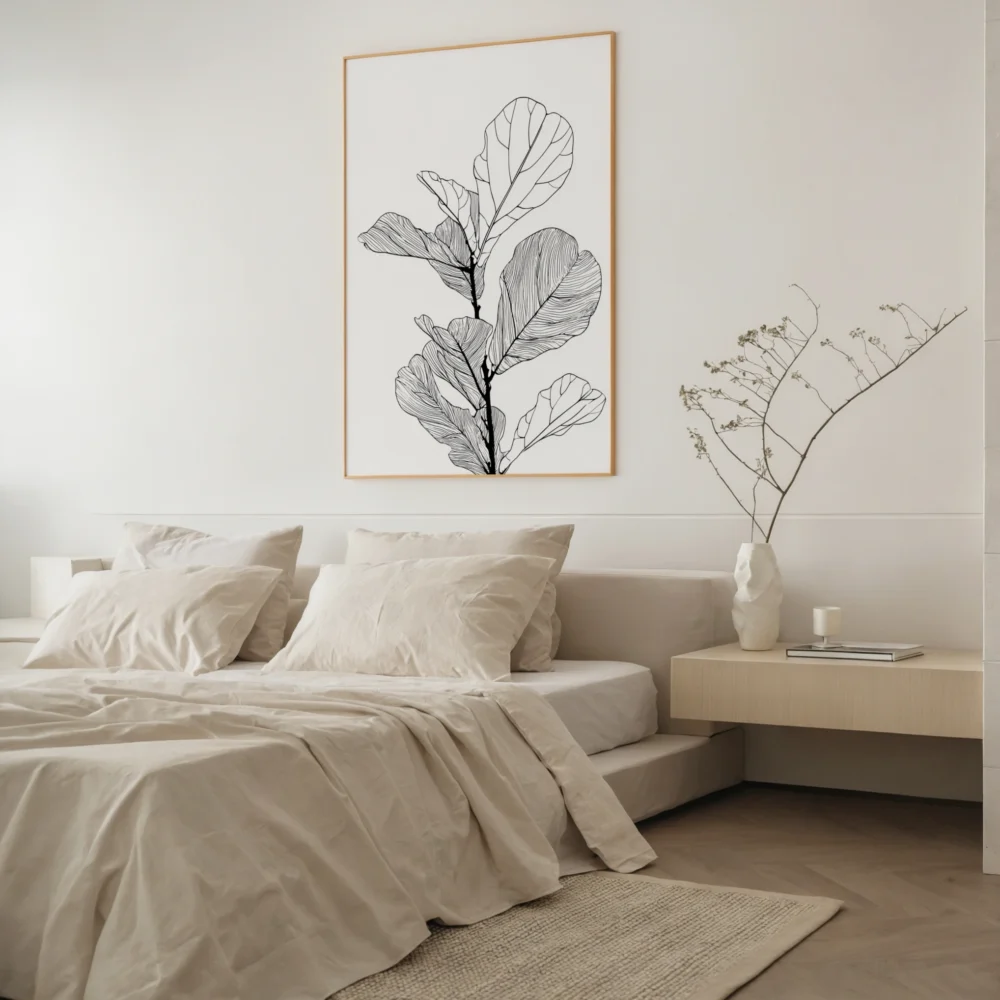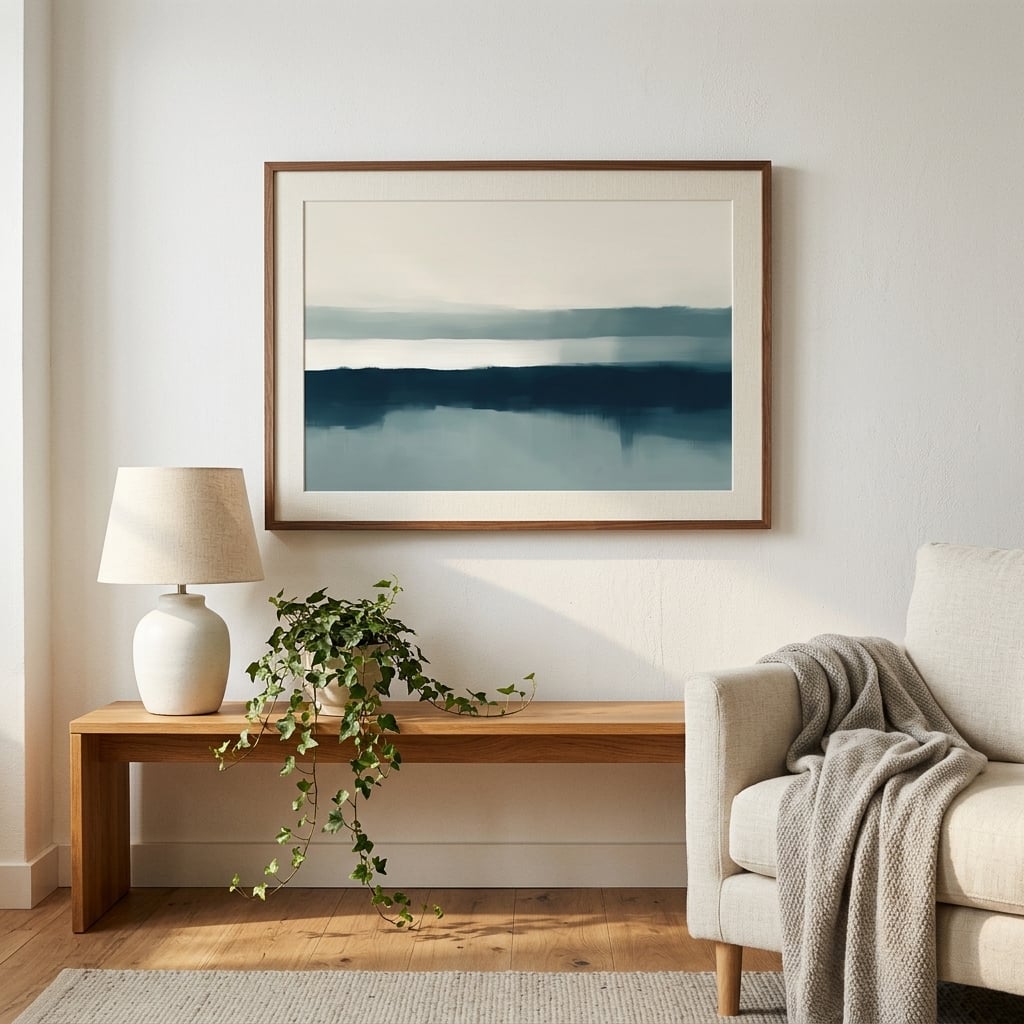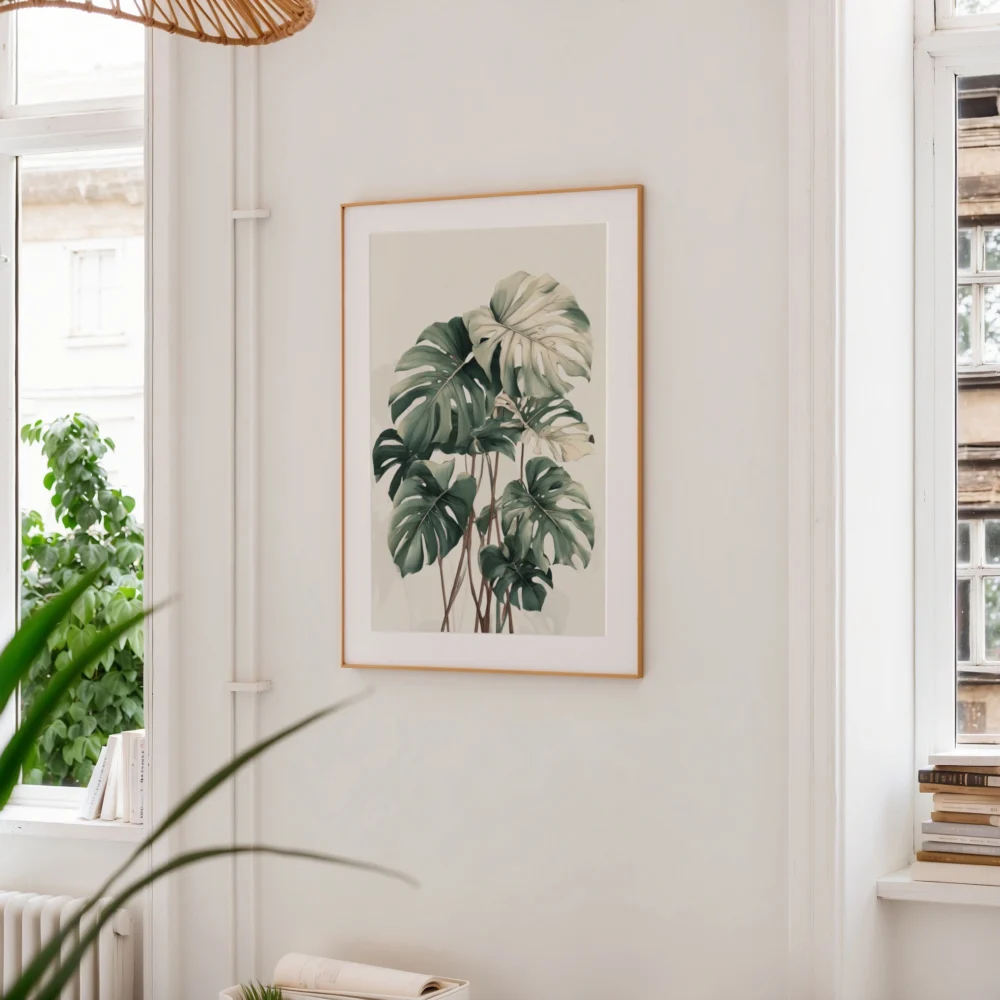
There is a word in Japanese that does not translate cleanly into English, and its absence from our vocabulary might be the reason so many rooms feel busy no matter how much you tidy them. The word is ma. It refers not to objects, but to the space between them — the pause, the gap, the emptiness that gives everything else room to breathe.
In Western decorating, empty space is usually treated as a problem to solve. A bare wall wants filling. A gap on a shelf wants an object. A blank corner feels unfinished. Ma reverses that instinct entirely. It treats the emptiness as the design — the quiet that lets the few things you have chosen actually register. Once you understand it, you cannot look at an over-styled shelf the same way again, and you cannot un-see it in your own home.
Why the emptiest rooms feel the most considered
Think of the rooms that have genuinely calmed you. A well-run gallery. A quiet hotel lobby. A Japanese tea room. A high-end boutique where a single object sits in a pool of light. None of them are full. What they share is restraint — a small number of deliberately placed elements surrounded by enough space that each one reads clearly. That space is not an accident or a sign the owner ran out of things to display. It is the entire effect.
The cluttered shelf fails not because the objects on it are bad, but because there is no ma between them. The eye has nowhere to rest. Every item competes with its neighbor, and the result is visual noise that the body reads as low-grade stress, even when you cannot name why the room makes you restless. Remove half the objects and the remaining half suddenly look intentional, even valuable. Nothing was added. Space was. That is the counterintuitive move at the heart of the idea: you improve the arrangement by taking things away.
Where Japandi actually comes from
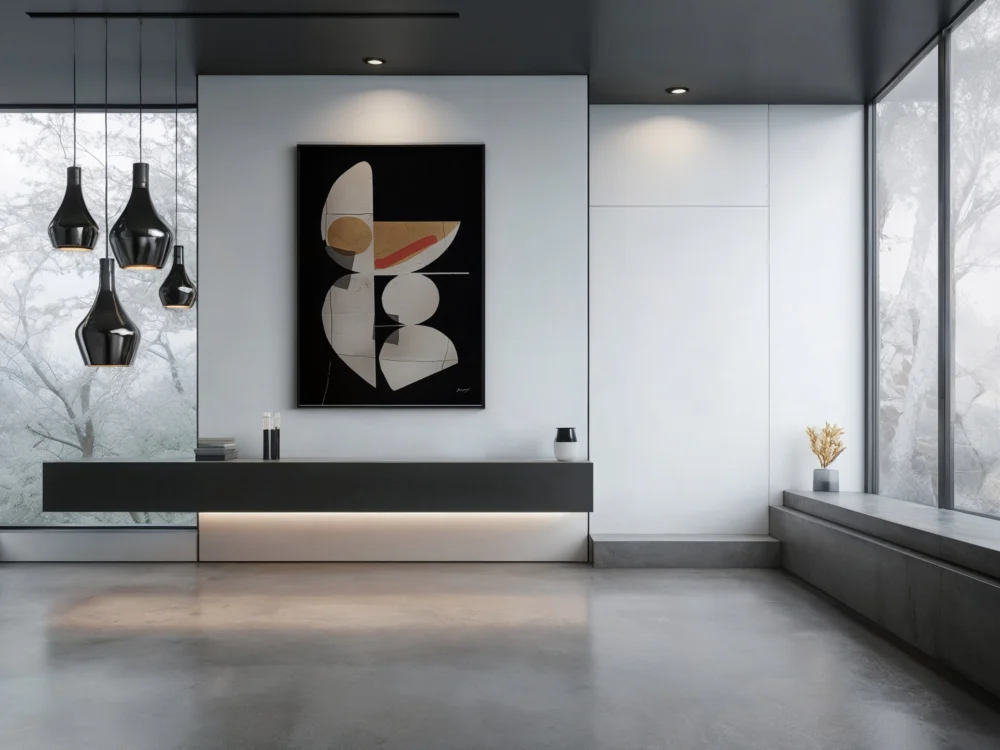
This is the idea sitting quietly underneath the Japandi style — the fusion of Japanese restraint and Scandinavian warmth that has become one of the most sought-after looks in modern interiors. Most people encounter Japandi as a surface: pale wood, muted earth tones, clean uninterrupted lines. But the aesthetic is really the visible layer of a philosophy, and ma is at its foundation. If you want to understand where the whole approach originates rather than just how to copy it, what Japandi art really is traces the thinking behind the look.
The Scandinavian half of the equation contributes the warmth — natural materials, soft diffused light, a lived-in comfort that keeps the minimalism from tipping into cold. The Japanese half contributes the discipline of empty space and the reverence for natural imperfection. Put them together and you get rooms that feel serene without feeling severe, which is a far harder balance to strike than the endless identical Japandi mood boards make it look. Japandi interior design works precisely because it holds those two forces — warmth and restraint — in tension rather than letting either win.
How to apply ma to a wall
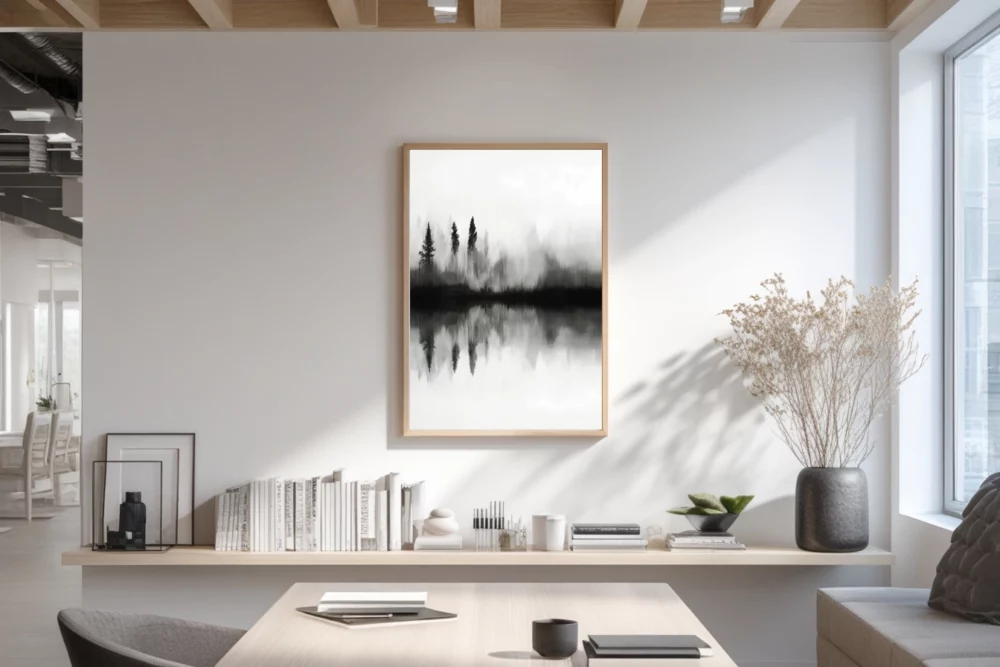
Walls are where most people abandon restraint entirely. The instinct with a large blank wall is to fill it — a grid of frames, a gallery cluster, a big statement piece flanked by smaller satellites. Ma suggests the opposite, and it takes nerve to follow. One well-chosen piece, generously sized, hung with plenty of clear wall around it, will almost always feel more considered than three or four pieces competing for the same space. The empty wall around the single piece is not wasted. It is framing the piece as surely as the frame itself.
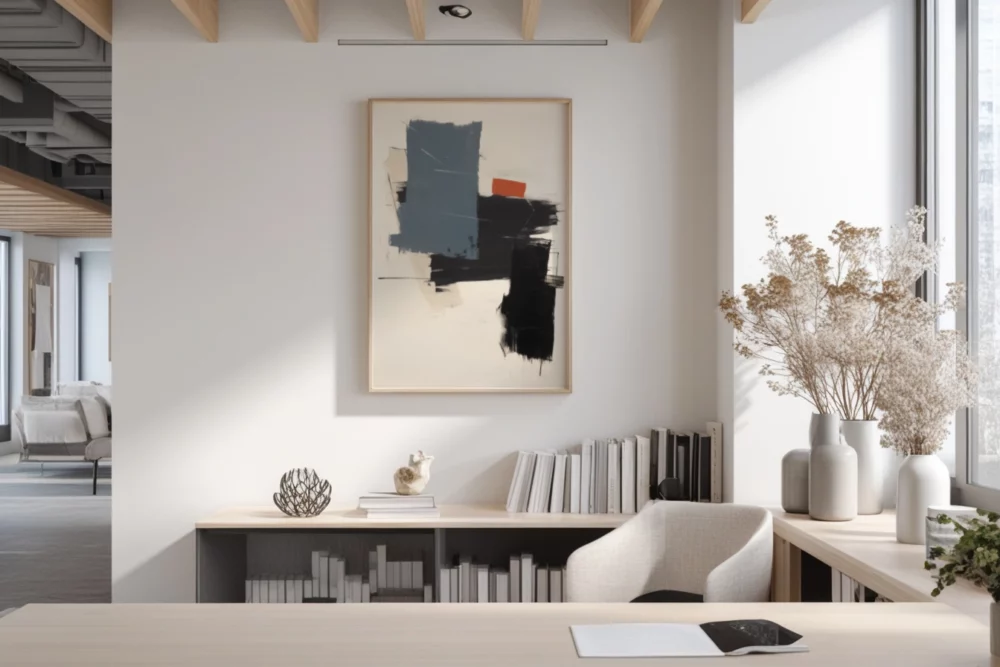
The art you choose should carry the same principle internally. A print crowded with detail and saturated color works against the calm you are trying to build, no matter how beautiful it is in isolation. Pieces with their own internal emptiness — a single botanical line, a minimal abstract form, a quiet neutral wash of tone — echo the space around them and amplify it. This is why Japandi art prints tend so strongly toward simplicity: they are designed to hold space rather than fill it, to be the calm element a room can finally organize itself around.
The shelf test you can run tonight
Here is a practical exercise that teaches the idea faster than any amount of theory. Take any shelf, mantel, or console in your home that feels slightly off but that you cannot quite diagnose. Remove everything from it. Every object, down to the last small one. Then put back only three things, spaced generously so that each has clear room on either side. Stop there, even though the instinct to add a fourth and a fifth will be almost physical. Live with it for a full day before you touch it again.
Almost everyone reports the same result. The near-empty surface looks more expensive, more deliberate, more like the interiors they save to mood boards and assume are out of reach. Nothing about the objects themselves changed — they are the same things that looked cluttered an hour earlier. What changed is that you gave them ma: room to be seen individually rather than as a crowd. The clutter was never really a decorating problem or a taste problem. It was a spacing problem all along.
The discipline of subtraction
What makes ma genuinely difficult to practice is that it runs against a powerful instinct. Acquiring feels like progress. Adding a cushion, a vase, a second frame feels like improving a room, because each individual object is, in isolation, a good object. The skill ma demands is the opposite one: the ability to look at a space that is technically fine and remove something from it anyway, trusting that the emptiness left behind will do more than the object did.
Interior designers describe this as editing, and they treat it as the hardest and most valuable part of the job. Anyone can fill a room. The talent lies in knowing what to take out — which of two good pieces to remove so the remaining one can finally be seen. When you start editing your own rooms this way, deliberately subtracting rather than always adding, you begin to produce the calm that no amount of careful shopping ever delivered. The room improves not because you found the perfect object, but because you gave the objects you already had room to matter.
Why this matters more in a small home
There is a persistent myth that restraint is a luxury of large homes — that only people with generous square footage can afford empty space. The opposite is closer to the truth. In a small home, every surplus object costs you more, because there is less room to absorb it. Clutter that a large loft can carry will overwhelm a small apartment entirely. This is exactly why the Japanese perfected the art of empty space in famously compact living quarters, and why the principle translates so well to modern city apartments.
In a small space, ma is not decoration philosophy — it is survival. A single well-chosen piece of art on an otherwise clear wall makes a small room feel larger, calmer, and more intentional than a gallery of frames ever could. The empty wall reads as generosity of space, which is the one thing a small home is assumed to lack. Restraint, applied here, does not just look good. It makes the room feel bigger than its floor plan, which is a kind of magic that buying more furniture can never perform.
Emptiness as a material
The hardest mental shift is learning to treat empty space as something you are actively using rather than something you are failing to fill. A bare stretch of wall is not an unfinished project. A shelf with visible room on it is not evidence you need to shop more. In the logic of ma, these are the design working exactly as intended — the pauses that make the notes audible.
This is also why the Japandi look is unexpectedly forgiving for people who do not think of themselves as decorators. You do not need to source dozens of objects and arrange them with professional precision. You need a few genuinely good pieces and the discipline to stop acquiring. The emptiness does the rest of the work, quietly and for free, exactly as it has in Japanese interiors for centuries. Choose less, space it well, hang one considered piece where you were tempted to hang three, and let the room breathe. That restraint is not the absence of a style. It is the entire style, and it is the reason the calm rooms feel calm.